
The soda drink industry thrives on delivering refreshing beverages that maintain consistent carbonation levels, essential for the drink’s texture, taste, and overall quality. Proper carbonation is crucial to customer satisfaction, as it directly impacts the mouthfeel and enjoyment of the beverage. This article explores the soda drink carbonation test, the ASTM F1115 standard, and effective methods used for measuring and controlling carbonation levels, ensuring high-quality soda drinks.
What Are Carbonation Levels in Soda Drink?
Carbonation in soda refers to the dissolved carbon dioxide (CO₂) that gives the beverage its characteristic fizz. The carbonation level is essential for controlling the mouthfeel, taste, and refreshment quality of the soda. Too much or too little CO₂ can significantly alter the beverage’s sensory properties. Proper carbonation also plays a vital role in the soda’s shelf life, as CO₂ retention helps maintain its effervescence over time.
The Importance of Carbonation in Soda Drinks
The level of carbonation in soda is determined by the amount of CO₂ dissolved in the liquid under pressure. It is critical for several reasons:
- Taste and Texture: Carbonation enhances the soda’s refreshing quality and creates a pleasant effervescent experience. Low carbonation can make the soda taste flat, while excessive carbonation can cause it to be overly fizzy.
- Shelf Life: CO₂ helps preserve the soda by creating a sealed environment inside the bottle, preventing spoilage and maintaining the product’s quality.
- Package Integrity: Maintaining the correct carbonation pressure is essential to prevent over-expansion of containers or leakage, which can compromise the product’s integrity.
Soda Drink Carbonation Test and ASTM F1115
The soda drink carbonation test is designed to measure and track the levels of CO₂ in the beverage over time. One of the widely accepted standards for measuring carbonation in beverages is ASTM F1115, which provides guidelines for evaluating CO₂ retention and carbonation loss during storage.
ASTM F1115 Method Overview:
ASTM F1115 outlines two main procedures for measuring carbonation in soda:
- Procedure A: This is a highly sensitive testing method typically used for laboratory research and the development of new packaging designs. It involves precise measurement tools like pressure transducers and thermocouples, which monitor the pressure and temperature of the closed system to track CO₂ levels.
- Procedure B: This method is more widely used in beverage production and quality control. It involves a simpler approach where a manual or automated CO₂ analyzer measures the pressure in sealed bottles over a set period. Procedure B is used to ensure that the CO₂ levels remain consistent throughout the production process and that bottles are filled with the correct amount of carbonation.
Testing Process
- Sample Preparation: A random selection of at least 50 soda drink bottles is tested, with each bottle filled with the carbonated beverage.
- Pressure Measurement: After sealing the bottles, they are agitated for 60 seconds to evenly distribute CO₂. A CO₂ analyzer is then used to measure carbonation levels, and the data is tracked over a defined period.
- Long-term Sampling: Carbonation levels are measured periodically over several weeks to determine how much CO₂ is lost over time and the drink’s shelf life. A typical guideline is a 15% carbonation loss indicating a 2% reduction in CO₂, which could signal the expiration of the product’s freshness.
Calculating and Tracking Carbonation Levels
The test involves calculating the percent CO₂ retention of each bottle, with the initial carbonation level set at 100%. The CO₂ retention of each sample is then calculated and plotted on a graph. The results show the shelf life of the soda and indicate when the carbonation level drops below the specified minimum guideline.
This method provides essential data for manufacturers to understand and predict when their product will lose carbonation and potentially spoil. It allows for the optimization of packaging and storage conditions to maximize shelf life and maintain the product’s quality.
Recommended Equipment for Carbonation Testing
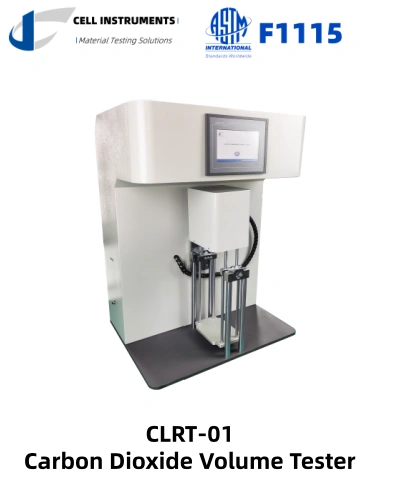
For accurate and reliable carbonation testing, the Cell Instruments CLRT-01 Carbon Dioxide Volume Tester is highly recommended. This equipment is designed for precise measurement of CO₂ volumes in carbonated beverages, ensuring that manufacturers can maintain the correct carbonation levels and improve their quality control processes.
Conclusion
Maintaining the proper carbonation levels in soda is essential to ensuring product quality, consistency, and consumer satisfaction. By using methods like the soda carbonation test and adhering to standards like ASTM F1115, manufacturers can effectively measure and control CO₂ retention, improve shelf life, and reduce waste. Regular testing and monitoring also help maintain optimal carbonation levels, ensuring that every bottle delivers the perfect fizz and taste.
For accurate and consistent results, investing in reliable testing equipment such as the Cell Instruments CLRT-01 can help ensure that your product meets industry standards and exceeds customer expectations.
 EN
EN  AR
AR  BG
BG  CS
CS  DA
DA  DE
DE  EL
EL  ES
ES  ET
ET  FI
FI  FR
FR  HU
HU  ID
ID  IT
IT  JA
JA  KO
KO  LT
LT  LV
LV  NB
NB  NL
NL  PL
PL  PT
PT  RO
RO  RU
RU  SK
SK  SL
SL  SV
SV  TR
TR  UK
UK